
BATR April 16 2014
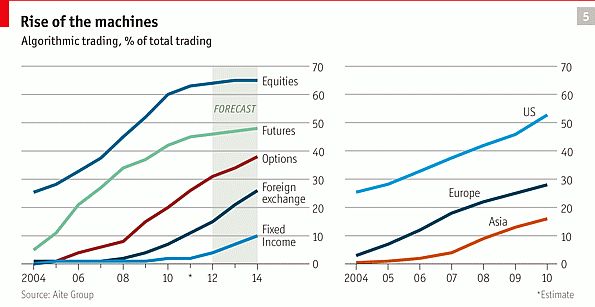
No one has ever claimed that the financial markets are a level playing field. Equities, bonds, currencies, options and futures are not arenas that operate by equivalent standards for all parties. Great fortunes were built not by chance, but on superior information, known to the few. Professional traders are not risk gamblers, but operate on the premise of special advantage. Through advance and proprietary techniques that reduce exposure hazards and provide exclusive head start triggers, which virtually guarantee profits, the elite firms dominate Wall Street.
Business Week states in the article, Is High-Frequency Trading Insider Trading?, that
“Classically defined, insider trading means having access to material, non-public information before it reaches the rest of the market; it’s like getting a heads-up about a merger before it’s announced, or maybe a phone call from a Goldman Sachs (GS) board member saying that Warren Buffett is about to invest $5 billion in the bank.”
With the introduction of super computers and Financial Algorithmic Trading, the era of generated trading strategies emerged that fill automatically, when predetermined prices are reached. Some would argue that exchanges were simply applying the latest technology to the time honored system of flipping positions.
 How would you feel if you went to the store to buy something, and someone rushed ahead of you and purchased it first and then sold it to you at a higher price? Well, in the financial world this happens millions upon millions of times. In fact, this practice has become so popular that it has spawned an entire industry known as “high frequency trading”. At this point, high frequency trading makes up about half of all trading volume on Wall Street, and it is costing the rest of us billions of dollars a year. And the funny thing is that this is all perfectly legal. High frequency trading firms are exploiting a glitch in the system, and by allowing this to go on, the authorities have essentially given them a license to steal from the rest of us. Sadly, this is just another example that shows that the odds are never in our favor. The “little guy” never seems to be able to win, and those at the top of the food chain like it that way.