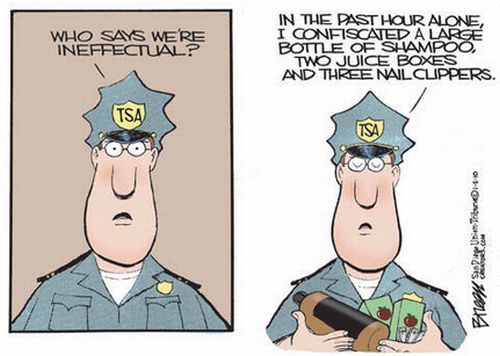
 John Vibes – Earlier this week, three former TSA agents were indicted on charges of defrauding the government and smuggling cocaine.
According to the indictment, 35-year-old Joseph Scott, 32-year-old Michael Castaneda, and 27-year-old Jessica Scott, all former TSA agents at San Francisco International Airport, were involved in an ongoing operation to help transport drugs through airport security.
Federal investigators were tipped off about the operation and sent undercover agents to arrange their own controlled deals with the TSA agents to gather additional evidence on them. Sting operations occurred between May 2013 and April 2014, where the TSA agents in question knowingly allowed large amounts of cocaine to pass through security checkpoints and through the X-ray scanners without an additional search.
Although, the evidence was collected last year, the suspects were just recently arrested before the indictment was unsealed on November 9th, 2015. Each suspect is facing massive charges that could land them in prison for the rest of their lives.
According to a press release from the Justice Department: Continue reading
 Conclusions drawn by behavioral science experts have confirmed that the TSA has wasted close to $1 billion on training screeners to look for suspicious body language and facial expressions at airport lines.
 Below is [May 26th’s] column in the Washington Post’s Outlook Section on the dangers of America’s growing administrative state. Ask any elementary student and you will hear how the Framers carefully designed a tripartite, or three-branch, system to govern the United States. This separation of powers was meant to protect citizens from tyranny by making every branch dependent on each other to carry out the functions of government. These three branches held together through a type of outward pressure – each holding the other in place through their countervailing forces. Add a fourth branch and the structure begins to collapse. That is precisely what is happening as federal agencies grow beyond the traditional controls and oversight of the legislative and executive branches. The question is how a tripartite system can function as a quadripartite system. The answer, as demonstrated by the last two decades, is not well. The shift from a tripartite to a quadripartite system is not the result of simply the growth in the size of the government. Rather, it is a concern with the degree of independence and autonomy in the fourth branch that led me to write this column.